From the journal · Scott Hinojosa
Comparative Religion by Region, Part III: West Africa Is Not One Religion
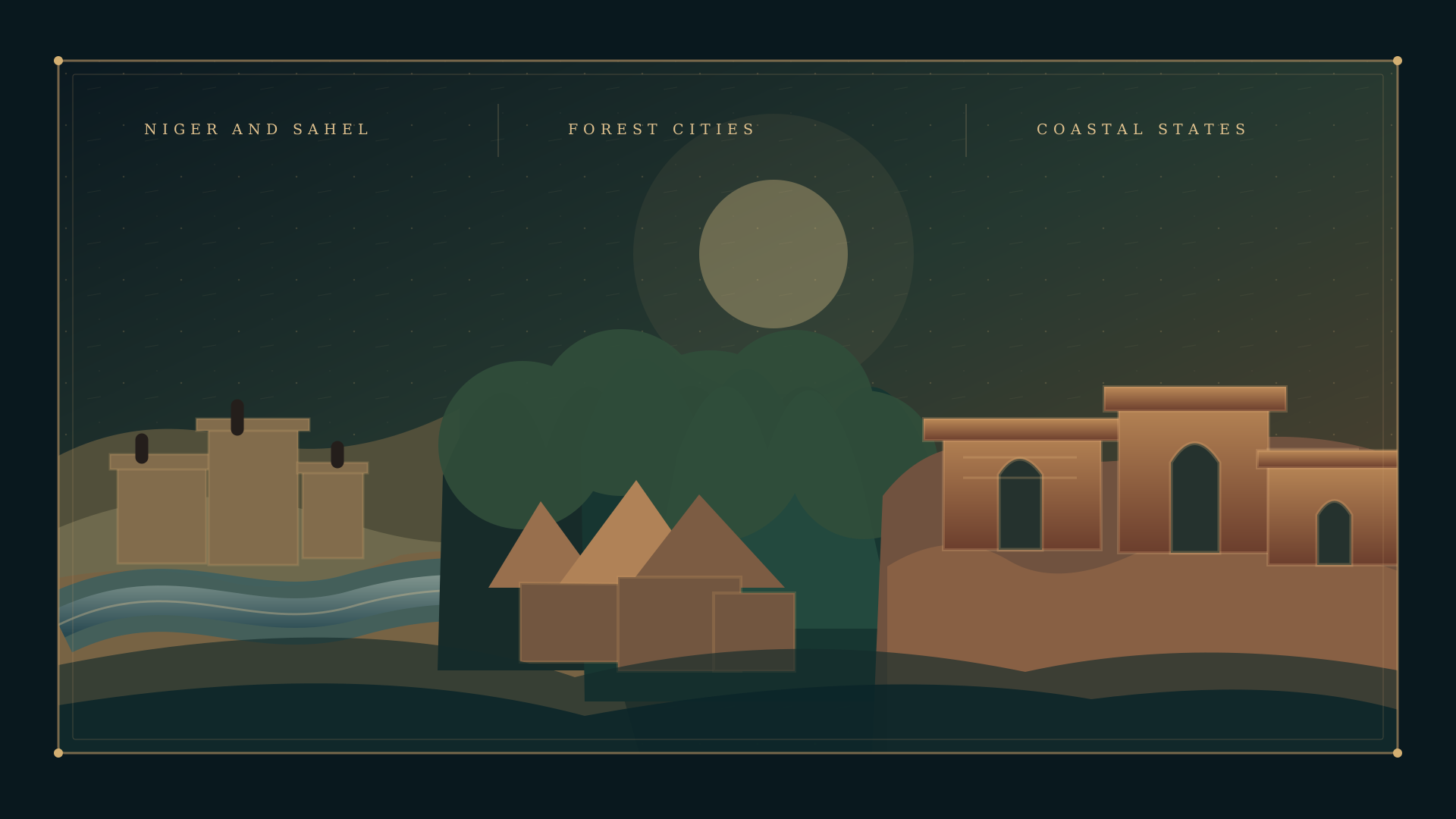
Before the Atlantic diaspora, West Africa had its own distinct religious worlds. Yoruba Orisha traditions, Fon and Ewe Vodun, Akan religion, Sahelian Islam and neighboring systems have connected histories, not a single identity.
A continent is not a religion. Neither is a region.
In Part I, I separated African Traditional Religions, African diasporic religions, and modern American reinterpretations. Now we need to make the distinction harder: even the traditions people routinely place under the label “West African religion” do not form one system.
Yoruba religious worlds, Fon and Ewe Vodun, Akan religious life, the traditions of Mande, Igbo, Edo and many neighboring peoples, and centuries of West African Islam and Christianity cannot be reduced to one set of interchangeable spirits. Their histories touch. Their categories do not always translate.
The area covered here runs from the western Sahel and the Niger River through the forest and coastal societies of today’s Ghana, Togo, Benin and Nigeria, with neighboring connections. That is a large, uneven geography. I am using selected, historically documented cases, not claiming to catalog every people in it.
To understand the present, start well before the Atlantic crossing.
Before written histories: the evidence is real, but incomplete
West Africa had settlements, farming communities, specialized crafts, trade, burial practices and changing relationships to land long before anyone wrote a description of “Yoruba religion” or “Vodun.” Archaeology can recover some of that life. It does not hand us a complete theology.
The Niger River and its inland delta supported settlements and exchange over many centuries. Jenne-jeno, near modern Djenné in Mali, developed as an important settlement from approximately the last centuries BCE. Its material record helps establish the depth of urban life in the Sahel. It does not tell us that every community along the Niger shared one spirit system.
In what is now central Nigeria, the Nok archaeological tradition left extraordinary terracotta work. Dates and interpretations have been revised as research has improved. The Metropolitan Museum’s more recent treatment places Nok’s beginnings as early as approximately 1500 BCE, while stressing how much remains unknown. The older habit of pointing to Nok sculpture and announcing that we have found the ancient origin of a specific present-day deity goes further than the evidence permits. The Met’s account of Nok and early African art and its earlier, more cautious discussion of Nok terracottas are worth reading together.
This is the first limit of comparison: an ancient object may show craftsmanship, status, commemoration or a possible ritual setting without telling us the divine name, liturgy or initiation structure associated with it.
Oral histories are also evidence, but they answer different questions. A community’s account of sacred origins can express political legitimacy, kinship and religious truth within that community. It is not automatically a modern archaeological date.
Prehistoric is not a synonym for unchanged. We cannot trace a straight, fully documented line from a prehistoric terracotta to a twenty-first-century shrine.
First millennium CE: many local worlds, then Islam through trade
By the first millennium CE, societies across the region were already developing different kinds of religious authority: relationships with ancestors, powerful places, divination, political and household rites, ritual specialists and community obligations. Even these broad similarities require care. An ancestor in one society is not the same religious category as an òrìṣà in another.
The material record at Igbo-Ukwu, in southeastern Nigeria, includes remarkable metalwork and burial contexts dating broadly to the ninth and tenth centuries. It suggests ritual and political complexity, but the identity and function of a particular buried individual remain debated. Igbo religious history cannot be filed under Yoruba religion just because both developed in the territory of today’s Nigeria. The Met’s Guinea Coast chronology, 500 to 1000 CE provides a useful introduction to the regional archaeological picture.
In the western Sahel, a different set of relationships expanded. Muslim merchants moved through trans-Saharan routes; Islamic communities took root among traders and then in some courts and towns from approximately the eighth and ninth centuries onward. Islam arrived through networks of exchange before it became the public religion of every ruler or household. The Ghana Empire, centered in areas of today’s Mauritania and Mali rather than the modern Republic of Ghana, included substantial Muslim trading communities while older religious institutions continued.
Conversion was not a single event. A king might support Islamic scholars or practices while subjects kept different religious obligations. A merchant could be Muslim in a town where other forms of worship remained locally authoritative. Later historians sometimes describe this as a simple replacement of “traditional religion” by Islam. It was often a much longer negotiation. The Met’s Western Sudan chronology, 500 to 1000 CE traces these early connections.
Eleventh to fifteenth centuries: Islamic empires and Yoruba sacred cities
The Mali Empire made Islam a major part of political and intellectual life across the Sahel. Mansa Musa’s pilgrimage to Mecca in 1324 is famous, but the larger story is the growth of scholars, mosques, legal traditions and trade institutions. It would be a mistake to conclude that every rural community, sacred place or household practice immediately matched the court’s Islamic commitments. Songhai later built on some of these networks, while religious differences and conflicts persisted.
Farther south, Ilé-Ifẹ̀ became a major Yoruba urban and sacred center. Its celebrated terracotta and metal arts flourished especially between roughly the eleventh and fifteenth centuries. Oral histories give Ifẹ̀ profound importance in accounts of creation, kingship and origins. Archaeology establishes impressive historical urban and artistic development; it does not independently verify every sacred episode in those histories. The Met’s account of Ifẹ̀ terracottas and Guinea Coast chronology, 1000 to 1400 help keep those evidentiary layers apart.
Yoruba religion is not simply a collection of deities waiting to be matched against gods elsewhere. Òrìṣà traditions are attached to particular communities, lineages, shrines, ritual knowledge and histories of place. Not all towns or practitioners hold identical accounts of every òrìṣà. Ifẹ̀’s history is not the history of the entire Yoruba-speaking world.
Ifá belongs in that world, but Ifá is not another name for everything Yoruba people believe. It is a highly developed divinatory and interpretive tradition, with its own signs, verses, specialists and forms of transmission. UNESCO describes the oral corpus and its continuing use in Yoruba communities and the diaspora. That is substantially different from treating a divination symbol found in a book as a self-authorizing spiritual title. UNESCO, Ifá divination system.
Nor should an account of Yoruba history erase neighbors. Edo-speaking Benin, Igbo communities, Nupe, Mande, Senufo and other peoples have had different institutions and overlapping contacts. The Kingdom of Benin, centered in today’s Nigeria, is not the same entity as the modern Republic of Benin, and Edo royal religious histories are not simply Yoruba material by another name. The names sound convenient together. The history is not convenient.
Sixteenth to eighteenth centuries: courts, coastlines and three different religious grammars
Expansion of trade and state power brought Yoruba, Aja-Fon, Ewe, Akan and neighboring societies into new kinds of proximity. It did not merge their religions.
In Yoruba-speaking regions, the Oyo Empire rose as a major political power. Local oriṣa worship, royal rites, divinatory authority and the institutions of different towns were part of a living network, not a frozen system controlled by one capital. The religious experience of a family in a particular town was not automatically identical to that of a court or a neighboring town.
In the areas of today’s southern Benin, Togo and Ghana, Fon, Ewe and related communities maintained traditions often discussed under the name Vodun. That term covers complex relationships with spiritual powers and with ritual institutions; it is not a single denomination with one standardized handbook. Historical developments around Aja-Fon states, Ewe communities and neighboring Yoruba-speaking populations sometimes involved shared, translated or contested religious forms.
The Kingdom of Dahomey, centered at Abomey from the seventeenth century, joined royal power to distinctive Aja-Fon ritual and political institutions. Do not confuse Dahomey with the whole of Vodun, and do not treat Vodun as simply an African version of Haitian Vodou. UNESCO’s record of the Abomey palaces describes the palace complex as political and cultural infrastructure with continuing ceremonial significance, not a museum label for an extinct faith. UNESCO, Royal Palaces of Abomey.
Among Akan-speaking peoples in today’s Ghana and Côte d’Ivoire, there were other arrangements of divinity, spiritual powers, ancestry, kinship and chiefly authority. Terms such as Nyame or Onyame for the high god, abosom for particular spiritual powers, and nsamanfo for ancestors occur in discussions of Akan religion, but their application and emphasis vary among communities. They should not be mechanically translated into “Yoruba supreme god, Yoruba òrìṣà, Yoruba ancestor.”
In Asante political religion, stools carry an authority that is not merely decorative. The Golden Stool expresses the soul and unity of the Asante polity. Other royal stools connect living authority to predecessors, with carefully maintained ritual relationships. The Asante state emerged around 1700, and its history must not be substituted for the history of every Akan people. See The Met on gold in Asante courtly arts and the Smithsonian’s discussion of an Asante royal stool.
Notice the difference: a Yoruba oriṣa, a Fon or Ewe vodun, and an Akan abosom may all be discussed by an outsider as “spirits.” That English shortcut does not tell you whether their mythic histories, obligations, ritual offices or social relationships match. Usually, they do not match neatly.
Fifteenth to nineteenth centuries: Atlantic captivity and religions that changed across the water
European maritime expansion and the Atlantic slave trade transformed the coast. The chronology overlaps with the growth of the states just described; there was no tidy switch from “traditional Africa” to “diasporic America.”
European merchants and empires created enormous demand for captive labor. African states, merchants and raiders participated in different ways, sometimes profiting, sometimes resisting, often both across changing political circumstances. None of that removes responsibility from Atlantic slave systems or makes the people enslaved interchangeable. Religious affiliation could cross the lines drawn by captors.
People transported to the Americas included devotees of Yoruba oriṣa traditions, people from Aja-Fon and Ewe worlds, Akan communities, Muslims, Christians and many others. They did not leave Africa carrying one ready-made “ATR package.” They carried incomplete, sometimes violently interrupted inheritances and tried to sustain or rebuild religious life under slavery. UNESCO’s overview of the transatlantic slave trade and its evidence shows why this history cannot be treated as a benign exchange of spiritual ideas.
That is one reason Haitian Vodou, Cuban Lukumí or Regla de Ocha, Brazilian Candomblé, and Trinidad Orisha should be treated as historically developed diasporic religions, not replicas to be measured against one supposedly pure African original.
Lukumí has substantial Yoruba roots but a Cuban religious history. Candomblé contains different nations and ritual lineages, including but not limited to Yoruba-associated Ketu and Fon-associated Jeje inheritances. Haitian Vodou has multiple West and Central African inheritances, as well as its own Haitian history and Christian entanglements. Shared names and relationships matter; they are not proof of identical institutions. An overview of the distinct traditions appears in the Library of Congress’s reference to Joseph Murphy’s Working the Spirit: Ceremonies of the African Diaspora.
The labels Vodun and Vodou look similar for a reason. That does not make every Haitian rite a direct photograph of life in precolonial Dahomey. Equally, the survival and reshaping of Yoruba material in Cuba does not make Cuban Lukumí illegitimate because it changed.
The nineteenth-century Atlantic also moved knowledge back toward Africa. Returnees from Brazil and formerly enslaved people resettling through Sierra Leone and elsewhere contributed to the architecture, churches, commerce and cultural life of coastal towns. Religious influence moved in more than one direction.
Nineteenth and twentieth centuries: conquest, conversion, reform and African choices
European colonial rule altered legal systems, schools, property, political authority and the status of Indigenous religious institutions. British expansion in the Gold Coast and Nigeria, French conquest in Dahomey and neighboring territories, and the work of missionaries changed the public terms on which communities could practice religion.
But Christianity in West Africa is not just a European institution imposed on passive people. African Christians founded churches, interpreted scripture, challenged missionary control and created new forms of worship and communal authority. African-initiated churches, including Yoruba-speaking prayer and healing movements, complicate any account that divides the modern region into “authentic traditional religion” versus “imported Christianity.”
Islam also kept changing. Sahelian scholarly traditions, Sufi orders, nineteenth-century reform movements and Muslim communities farther south followed different trajectories. The Sokoto Caliphate, established in the early nineteenth century in what is now northern Nigeria, is not an explanatory shortcut for every Muslim in the western Sahel, Ghana or Yorubaland. Islam’s history in the region includes debate within Islam, not simply contact between Islam and non-Muslim religions.
An African Muslim, Christian or Indigenous religious practitioner may share language, ancestry, kinship obligations and social settings with neighbors of other faiths without regarding their religions as the same. People also sometimes move between traditions, participate across boundaries or contest those boundaries. That is a historical fact, not proof that all religious differences are imaginary.
Colonial administrators and missionaries left written descriptions of “native customs.” Some preserve valuable observations. Others reorganize traditions through racist hierarchies, translation errors or assumptions that a religion needs a single creator, priestly hierarchy and sacred book to count as a religion. Read those records against African voices and living institutions, not as neutral inventories.
Independence and today: continuity is work, not a museum exhibit
The twentieth and twenty-first centuries brought independence, urbanization, new media, international migration, Muslim and Christian reform, cultural revival and transatlantic religious networks.
In southwest Nigeria, the Osun-Osogbo Sacred Grove is still an active religious place associated with Osun and Yoruba communities. UNESCO documents both its older sacred setting and the twentieth-century artistic work that renewed its structures and public visibility. A living tradition can have newly created art without thereby becoming a modern invention. UNESCO, Osun-Osogbo Sacred Grove.
UNESCO also recognizes the Gèlèdé oral heritage practiced by Yoruba-Nago communities across Benin, Nigeria and Togo. Its masks, songs and public performance relate to specific social and religious responsibilities. Displaying a carved mask on an American wall does not recreate that institution. UNESCO, Oral heritage of Gèlèdé.
Akan chiefly rites and the political meaning of stools are not artifacts of a vanished people. Vodun communities in Benin and Togo remain living, internally varied religions, not merely the ancestral supply closet for the Caribbean. In the wider region, Islam and multiple Christian traditions are major parts of contemporary public and private life, while Indigenous obligations may continue in visible or less visible forms.
The diaspora keeps the conversation moving. Initiates, priests, scholars, families and artists travel between West Africa, the Caribbean, Brazil, Europe and North America. Practices can be renewed or contested through those exchanges. Modern internet culture also turns sacred names into aesthetics, algorithms and personal brand identities. The two processes are not equivalent.
What we should stop calling “West African spirituality”
Here are the errors I keep seeing.
Yoruba is not the name of all West African religion. Not every religious object from Nigeria belongs to an òrìṣà tradition. Edo, Igbo, Nupe and neighboring religious worlds have their own histories.
Vodun is not a convenient spelling for all African religions. A Fon or Ewe religious institution and a Haitian Vodou house may be historically related without carrying identical obligations or histories.
Akan religion is not Yoruba religion with different divine names. The relation of an abosom to a community, or a royal stool to ancestral and political authority, deserves explanation on its own terms.
Islam and Christianity are part of West African history, not interruptions that can be edited out to make an “authentic Africa” easier to sell. Their local forms developed through African institutions, not only through outside commands.
Diasporic religions are not fake African religions; modern individual eclecticism is not automatically one of those diasporic religions. The history, community, training and authority matter.
I am an omnist. I can recognize insight in several systems without pretending they teach the same thing. Comparison starts when you put two traditions next to one another and can still tell which is which.
That means knowing what is attested, what is inherited through living community, what is remembered through oral history, and what is a contemporary personal interpretation. It also means being able to say, “I do not know,” instead of filling gaps with a familiar spiritual story.
West Africa never needed one religion to make its histories worth studying. Its differences are the point.
Historical references and further reading
For the ancient record and its limits: The Met’s Arts of Africa overview, Nok terracottas, and the Met chronologies for the Guinea Coast, 500 to 1000, Guinea Coast, 1000 to 1400, and Western Sudan, 500 to 1000. For distinct living traditions: UNESCO on Ifá, Osun-Osogbo, Gèlèdé, and Abomey. For Akan political religion: The Met on Asante gold and stools. For the Atlantic and diaspora: UNESCO on the slave trade and the Library of Congress entry for Joseph Murphy’s comparative study.
Comparative Religion by Region traces the oldest recoverable evidence through migration, trade, empire, conversion, colonialism and the living present without confusing source traditions, diasporic developments and modern reinterpretations. Previous installments: Part I, ATR and What America Made of It and Part II, North Africa Was Never One Faith.
Continue reading
More from the journal.
Comparative Religion by Region, Part II: North Africa Was Never One Faith
From prehistoric Saharan evidence to Amazigh societies, Punic religion, Jewish and Christian communities, Islam, empires and diaspora: North Africa cannot be reduced to one religious identity.
Read on
Comparative Religion by Region, Part I: ATR and What America Made of It
African Traditional Religions, African diasporic religions, and modern American spiritual reinterpretations are related, but they are not the same thing.
Read on
Where it leads
If this sounds familiar, the next step is simple.
The point is not to collect better language for the same patterns. The point is to identify what is running and decide what happens next.