

A woman sat across from me once, cards face down between us, and told me she did not have a temper. She said it pleasantly. She said she had done a lot of work on herself and she simply was not an angry person anymore. About ten minutes later I mentioned, in passing, the kind of mother she had described earlier in the session, and her whole face changed. Her voice went up half an octave and got very precise, the way a voice gets when it is holding a door shut from the inside. She laughed it off. She said that topic just annoyed her, that was all. I did not argue with her, because there was nothing to argue about. I had just met the part of her she swore did not exist, and it had introduced itself faster than she could stop it.
That is how the shadow usually shows up. It does not arrive in a black cloak. It arrives as the reaction that is bigger than the moment calls for.
Jung gave us the word, so it is worth being precise about what he meant by it, because the term gets used loosely now. In Aion, he called the shadow “a moral problem that challenges the whole ego-personality,” and he meant moral in the plain sense: this is the part of you that knows what you did, what you wanted, and what you would rather not have on the record. His own shorthand was that the shadow is the thing a person has no wish to be. It is built out of one life, yours. Everything you had to disown in order to stay lovable, acceptable, or safe in your own house went into it. The anger, because anger got you punished or got you called names. The envy, because envy was ugly. The hunger, because wanting things made you selfish. The need, because needing people made you weak. So those parts got sent out of the room, the way a child gets sent out of the kitchen for making noise. Here is the part people forget: sending a part of you out of the room does not retire it. It just stops telling you what it is doing. It keeps living, unsupervised, in the basement of you, and it gets on with its life down there whether you visit or not. Jung also observed that the less the shadow is embodied in a person’s conscious life, the “blacker and denser” it is, and that matches what I see across the table. The parts you refuse to know do not get smaller. They get more concentrated.
Precision matters for another reason, and this is a distinction the popular version of the work almost always skips. Jung separated the personal shadow from the collective one. The personal shadow is biographical. It is built from your own repressed and unlived material, it has your childhood in it, and it is the part you can actually work with. The collective shadow is the disowned material of a whole family, a culture, an era: the cruelty a country agreed not to see in itself, carried by everyone who grew up breathing that air. People fold the two together constantly. When someone tells me their shadow work keeps surfacing the violence of the century, they are usually not wrong about the century, but they may be using it to avoid the smaller, more embarrassing inventory that is actually theirs. The collective shadow is real, and it works on all of us. It is just not the door you start with. You start with the six year old in the doorway being told to lower her voice.
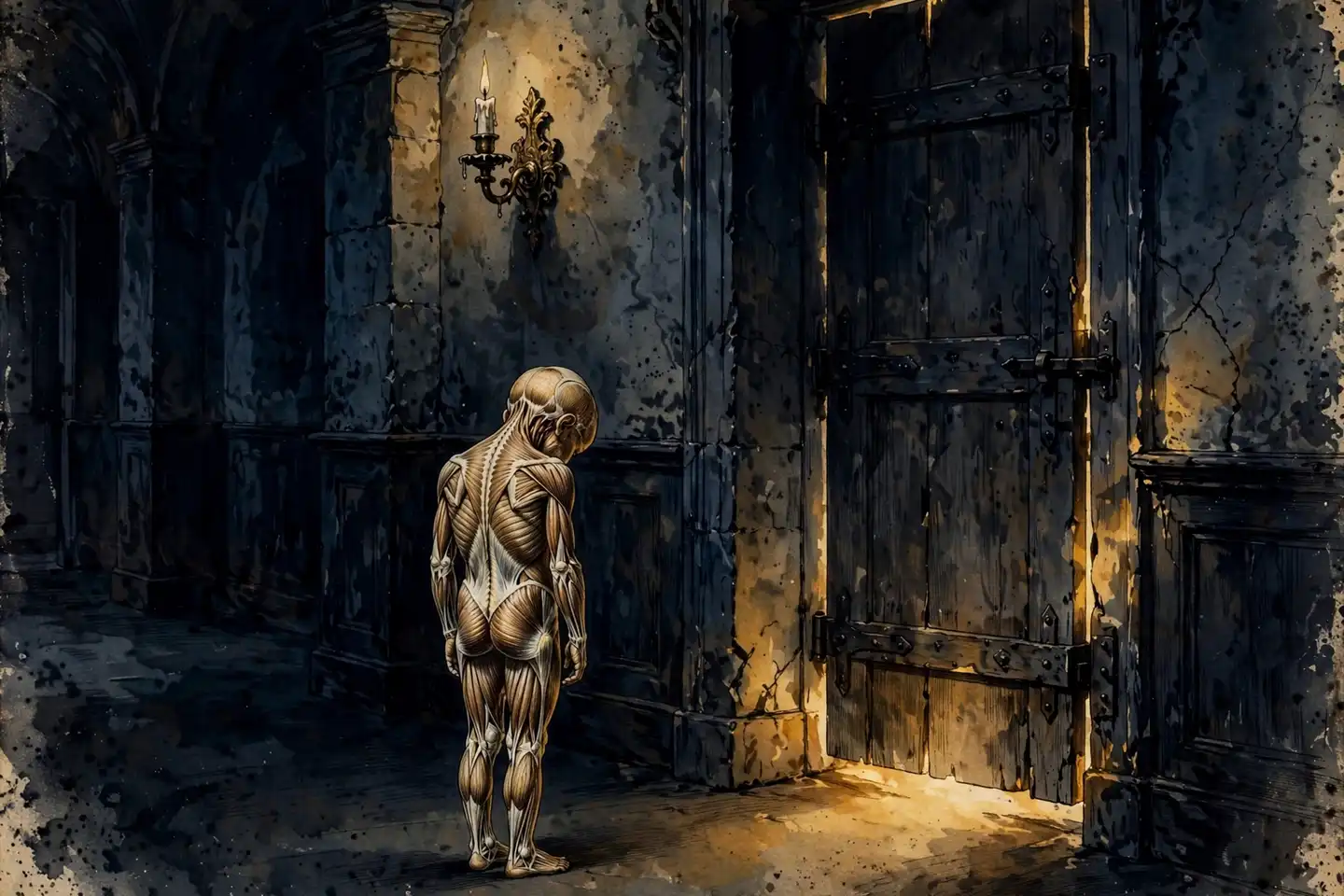
There is also the face you built instead. Jung called that the persona, the mask assembled out of whatever the world around you rewarded, and the shadow is roughly everything the mask could not afford to show. My generation learned to build that mask twice over. We were raised analog, when the public face was for school and church and the neighbors, and then we came of age digital and learned to curate a second face for an audience that never slept. Neither face is fake, exactly. Both are just expensive, because whatever they cannot hold gets handed downstairs to the shadow to carry.
Alice understood this, in her way. The looking glass was never really about another world. Step through it and everything is reversed, and the reflection is you, and the reflection argues back. That is the truest picture of shadow work I know. The thing on the other side of the glass is not a stranger and it is not a monster. It is you, flipped, saying the sentences you trained yourself never to say out loud. Most people would rather smash the mirror than have the conversation. The work is having the conversation.

So how do you actually dive? People imagine shadow work as a big dramatic descent, a weekend of crying and journaling and breakthroughs, and I will be honest with you: the dramatic version is usually theater. Real shadow work is administrative. It is unglamorous, repetitive, and mostly done on ordinary days with a notebook and some patience. Here is the shape of it as I have taught it and lived it for years.
You spot it by the overreactions. Not by your feelings in general, but by the spike. The stranger whose confidence irritates you completely out of proportion. The compliment you cannot let land, that you have to deflect or return within seconds. The family member whose ordinary comment leaves you shaking in the kitchen an hour later. The reaction you apologize for at night and cannot explain in the morning. Where the response is three sizes too big for the event, something underneath got stepped on. That is the unsupervised part, working without permission and without a job description. Jung had a name for the mechanism, too: projection. What you cannot own in yourself, you meet in other people with a charge on it, and the charge is the tell. You recognize the material so fluently because it is yours.
Then you name it like a person. This sounds strange until you try it. The exiled parts of us are not concepts; they are young and specific and they have histories. The angry one is often six years old and standing in a doorway being told to lower her voice. The envious one is often a teenager who watched someone else get chosen and decided the choosing was fixed. When you name the part, give it an age, and ask what it has been protecting all these years, the answers stop being abstract. The anger was protecting a boundary nobody else would hold. The envy was protecting a dream you buried and called dead because wanting it hurt less than mourning it. The need was protecting you from ever being stranded the way you were stranded once. Almost every shadow I have ever met was a bodyguard who never got told the war was over.
Then you give it one honest job it is allowed to do in daylight. This is the step that changes things, and it is small on purpose. The anger gets to say no once, cleanly, in a low voice, instead of exploding sideways in traffic. The envy gets to write down what it actually wants, as information, not as a verdict on your character. The need gets to ask for one thing directly instead of hinting for a week and resenting the silence. You do not have to love your shadow. You have to stop pretending it is not in the room, because what gets named gets a say, and what stays exiled runs the show.

It helps to know what all of this is for, because Jung had a frame for it and the frame is bigger than feeling better. He called it individuation: the long process of becoming the whole person you actually are, instead of the acceptable fraction of her. He treated the conscious meeting with the shadow as the first real stage of that process, the apprentice piece of the work, on the grounds that nothing deeper can be built on a self that is still lying about its own contents. Later generations of Jungian writers developed the idea further, and the honest ones will tell you that shadow work as the internet sells it, a weekend of prompts and catharsis, would have startled him. He meant something slower and more morally serious, a reckoning you return to for years. I would rather teach it at his speed than at the feed’s speed.
What changes, when you keep at this, is not that the shadow goes quiet forever. It does not, and anyone who promises you that is selling something. What changes is the volume and the timing. The spike that used to run your whole evening becomes a spike you notice while it is happening, and noticing is most of the battle. The basement gets quieter, not because its occupant left, but because it finally has work upstairs and a door it is allowed through. People describe it as feeling like themselves on a good day, more often. I think that undersells it. It feels like living in a house where you are no longer afraid of one of the rooms.
I want to be plain about the depth here, because this is where people get hurt. There is a shallows end of this work and it is genuinely useful: noticing your patterns, catching your spikes, learning your own tells. Everybody should wade there. But diving deep is different. Go down far enough and you are not meeting quirks anymore. You are meeting grief that never got a chair, and rage that has a real address, and years of your life that you have been walking around instead of through. I have done bodywork for almost twenty years, and I can tell you the body keeps those rooms the way the mind keeps stories, and opening one is not a weekend project. Go in with respect. Go in with support, a person or a practitioner who can sit in the room with you and is not frightened of what lives there. And go in at the speed of honesty, not the speed of content.

The guard I put on all of this, and I put it on everything I teach: grasping the concept is not doing the work. You can read one essay, this one included, and walk away feeling that you understand your shadow now. You have grasped one piece of grass. The meadow is bigger, and it is yours, and it will take the time it takes. The woman I mentioned at the start did not fix her temper that day, because her temper was never the problem. She just finally met the part of her that had been holding the door shut for thirty years, and she stopped calling it nothing. That is what a dive actually buys you. Not a new personality. A whole one, with all the rooms lit, including the basement.
You do not have to love what you find down there. You have to be willing to know it is yours.
If this landed and you want a human in the room, tell the concierge what is going on.
Begin with the concierge