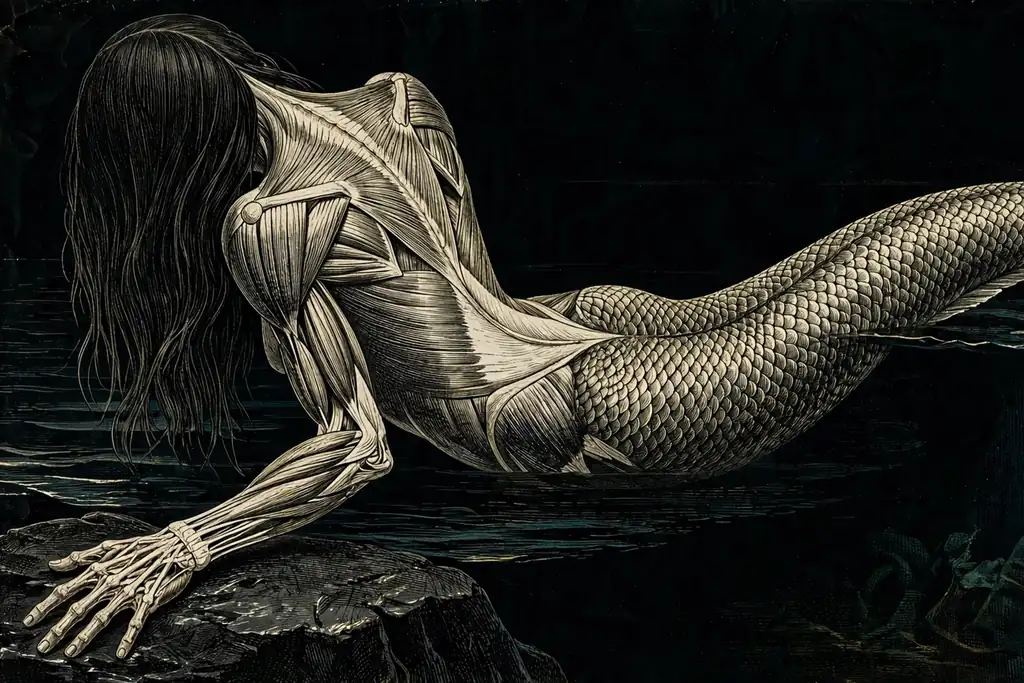
Every coastal culture on earth has looked at the water and decided that something in it was looking back. What is not universal, and where people get into trouble, is assuming that everything with a tail and a woman’s face is the same creature in different clothes. It is not. These beings come from different peoples, different waters, and different moral worlds, and they do not want the same things from you. One piece of method first. Every figure here arrives in layers: the tradition’s own account, kept by the people who lived with the story; the scholarly reading, built afterward from the records; and the modern retelling, which is art, and knows it, or should. Honest work means knowing which layer you are standing on.
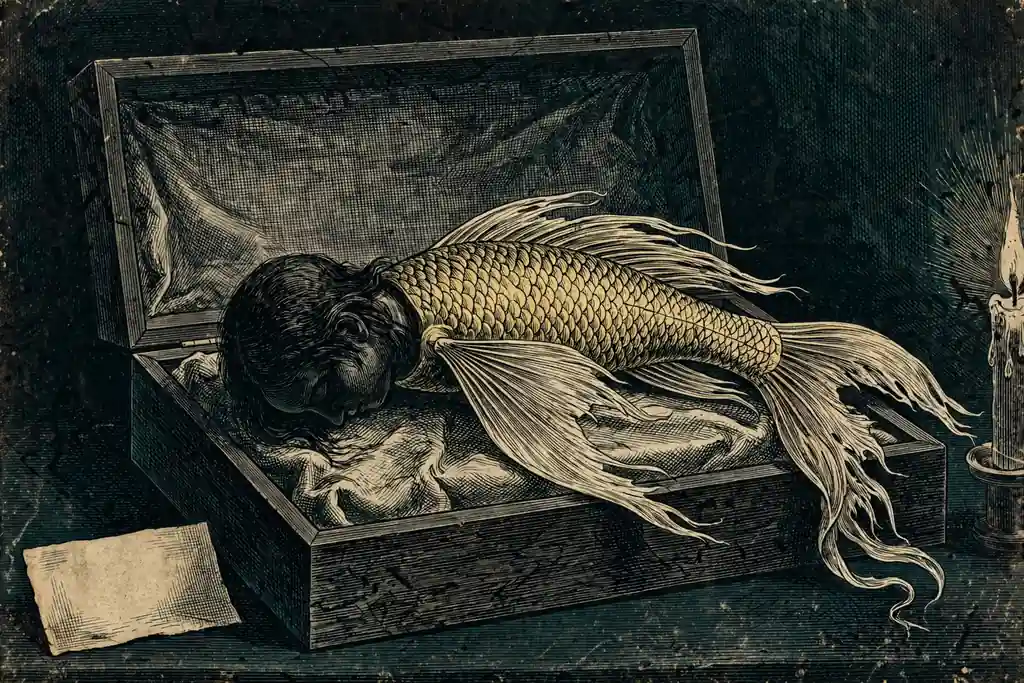
Start in Japan, with the ningyo, whose name is written with the characters for “human” and “fish.” The ningyo of the tales is not a maiden at all: a fish-bodied creature with a humanlike face, golden scales in some tellings, a voice like a bird or a flute. The written record reaches back. The court chronicle Nihon Shoki, compiled in 720, already preserves a report from 619 of a creature like a human child taken from a river and read as an omen. A thousand years later, Edo period broadsheets were still reporting ningyo washed ashore or taken in nets, carrying the same warning: storm and hard luck travel with this fish. But the flesh is the darker heart of the tales. Eat it, the stories say, and you may gain a life far longer than a human life, and the gift is never clean. In the legend of Yao Bikuni, the eight-hundred-year nun of Wakasa, a girl eats the flesh of a strange fish brought home to her father’s house and stops aging. She outlives husband after husband, generation after generation, and at last takes vows in a temple, because centuries of outliving everyone you love is a sorrow dressed as a blessing. Temples kept mummified ningyo as treasures, and here the scholarly layer gets its say: one famous temple mummy, CT-scanned and X-rayed by university researchers in 2023, proved to be a made thing, cloth, paper, cotton, and fish skin shaped by human hands. The lore is not shrunk by that. It is measured by it: people wanted the story to be touchable.
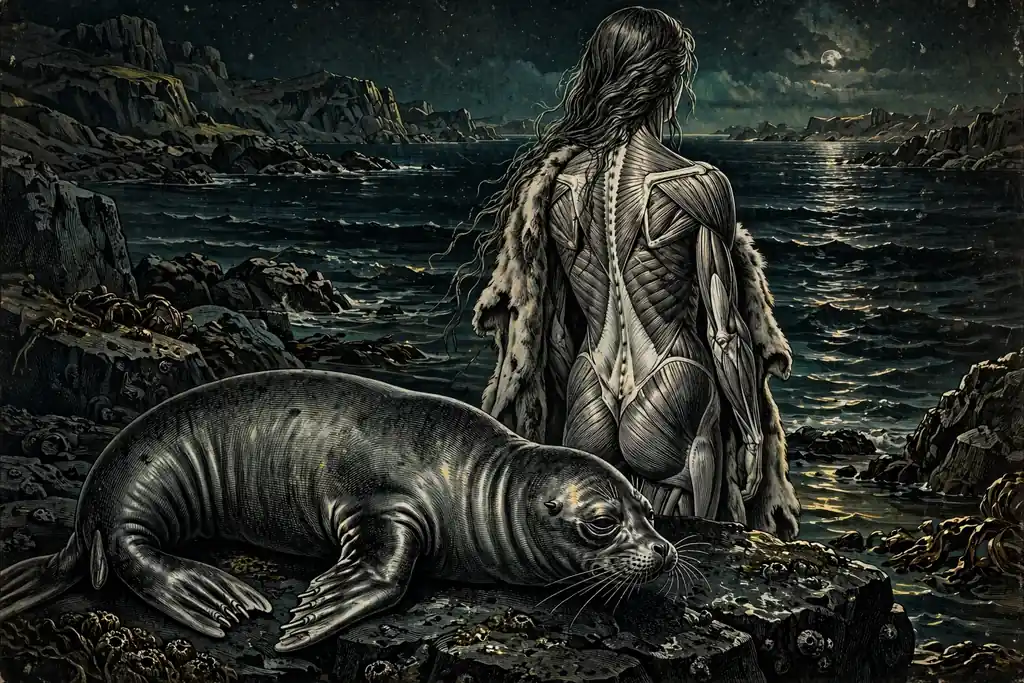
Cross to Scotland and Ireland and you meet the selkies, and the whole emotional shape changes. The word is plain Scots, from selch, a seal: a selkie sheds her skin on land and stands up as a woman, or a man. The ballad tradition gives us the man first. In “The Great Silkie of Sule Skerry,” catalogued by the collectors as Child 113, a silkie father comes ashore to pay the nursing fee for his son, and foretells the day both he and the boy will be shot as seals. The tale tradition, written down by the Orcadian folklorist Walter Traill Dennison in the late 1800s, turns on the skin. A fisherman steals a selkie woman’s sealskin and hides it, and because she cannot return to the sea without it, she stays and becomes his wife. She is often a good wife in the telling, and that is what makes the stories ache: the marriage is a captivity with kindness in it. One day she finds the skin, sometimes handed to her by her own unknowing child, and she goes back to the water, because the sea is not a place she visits. It is what she is. Folklorists class the selkie wife with the swan maidens, a family of tales spread across half of Eurasia in which a man holds a supernatural bride by holding her covering. The filing is true as far as it goes; the island tellers took it further.
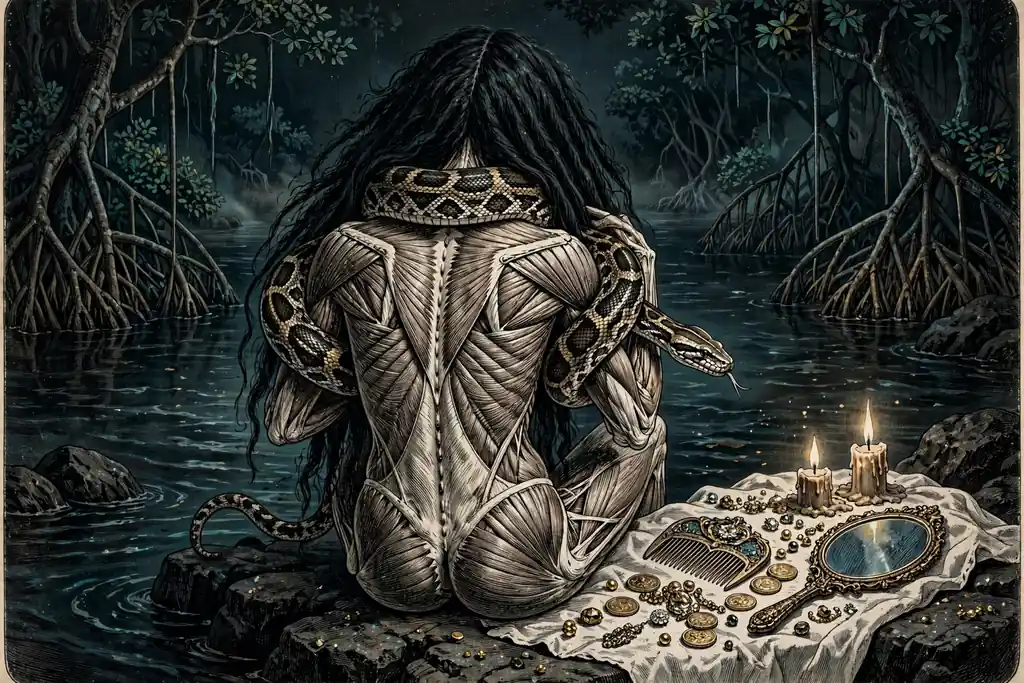
West and Central Africa give us Mami Wata, and she refuses every gentle category. Her name is pidgin, “Mother Water,” and the name is younger than the worship: European traders’ accounts from centuries ago already describe offerings to the powers of sea and river along that coast. In the art she is shown with snakes, mirrors, combs, and glittering goods, and her devotees know her as a bringer of fortune who can withdraw it as fast, a spirit of money, beauty, sexuality, and the peril of wanting what comes from over the water. The scholar who did the deepest work on her, Henry John Drewal, traced her most famous portrait to a chromolithograph struck in Hamburg of a Samoan snake charmer who had toured Germany in the 1880s, reprinted in India and carried to West Africa along the trade routes. But Drewal’s own caution matters more than the tracing: the picture traveled, he argues, because the spirit was already there to receive it. The image is imported. The power is not. Her face crossed the Atlantic too, onto Caribbean altars and the flags of the Haitian sea spirit La Sirène. The tradition itself is blunter than the scholarship. She gives, she takes, she is owed devotion and exactness, and nobody sane treats her as a decoration. She is a power with a water address.
In the Slavic river country, the rusalka waits, and she is something else again. In the folk belief recorded by ethnographers, rusalki are the dead. The Russian folklorist Dmitry Zelenin set them among what he called the unclean dead: those who died before their time or by violence, the drowned, the unbaptized, souls with a claim outstanding against the world. Linda Ivanits, in her standard survey of Russian folk belief, treats them the same way. They belong to a season as much as to a river: in Rusal Week, at the early summer feasts, they were believed to leave the water and swing in the birches and walk the rye, and villages held rites to see them off again. In the tales they sing, they lure travelers toward the water, and in some tellings they tickle a caught man to death. Whether the word descends from Rosalia, the Roman rose festival, scholars have argued for a century without settling; the belief needs no Rome to explain it. What came later is the softening. Pushkin left an unfinished drama about a rusalka wronged and returned for vengeance, and in 1901 Dvořák’s opera, its libretto built from Czech fairy tales with Andersen in its ancestry, gave Europe a lovesick water nymph pining for a soul. That is the modern retelling, lovely and false to the older record. Underneath it the rusalka is a haunting, not a species: a particular person whose death went unfinished, and grief and vengeance are her whole weather.
France gives us Melusine, and here we can name the book. In 1393 Jean d’Arras composed the prose romance of Melusine for his patron, the Duke of Berry, from older stories told of the house of Lusignan. She is a woman from the waist up and a serpent from the waist down one day in every week, and she hides that day behind a bargain: marry me, build with me, grow rich with me, but never seek to see me on a Saturday. Raymondin agrees, and the castles rise and ten sons come and the house grows great on her labor. The history beneath the romance is real: the Lusignans became kings of Cyprus and of Jerusalem. Then, goaded by his brother’s mockery, Raymondin pierces her door with his sword and sees her in her bath, serpent to the waist, beating the water with her tail. The bargain breaks, not because she is monstrous, but because he is faithless, and she departs in serpent form with a cry her family, the chroniclers say, heard for generations at the death of every lord of the house. Melusine bargains, builds, keeps her word, and mourns. Read her beside Andersen’s little mermaid and feel the difference in the hand. Andersen’s tale, published in 1837, is literature: an invented mermaid who trades her voice for legs and a chance at an immortal soul. Most of us now meet her first as an animated film in a white clamshell video box, one more layer between us and the folk record. Melusine came out of a people’s memory of a founding mother who was never entirely human and never asked to be.
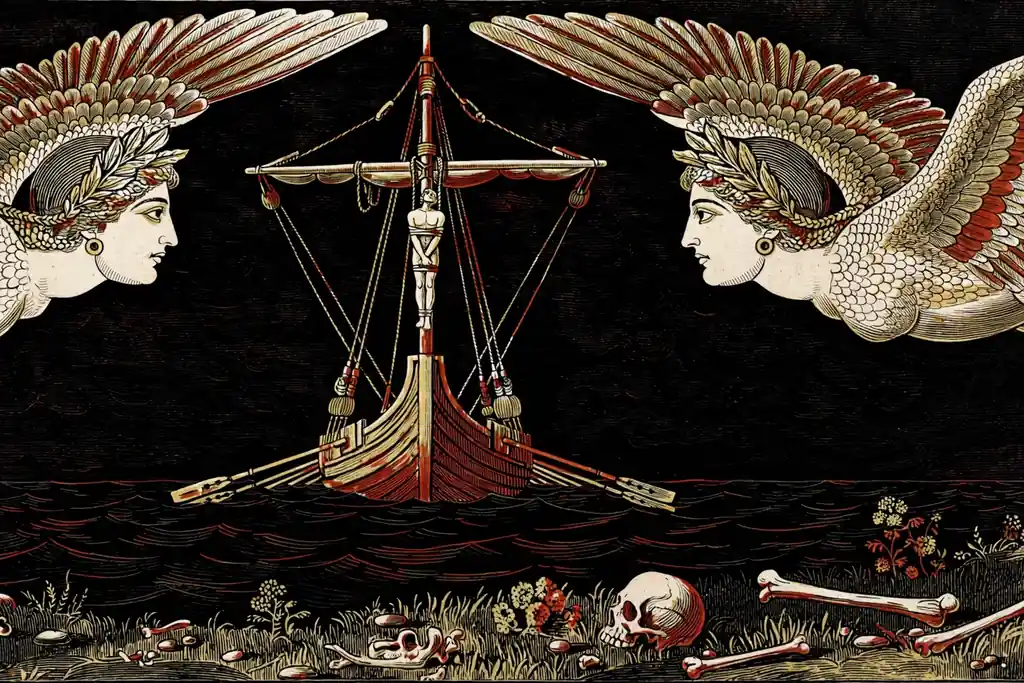
Greece finishes the walk with the hardest correction of all, because the Greek sirens did not have fish tails. Homer, in the twelfth book of the Odyssey, never describes their bodies at all: he gives us two of them, his grammar uses the dual number, a meadow, a pile of bones, and the song. The bodies come from the artists. On a red-figure wine jar painted about 480 BCE by the artist we call the Siren Painter, now in the British Museum, Odysseus hangs tied to his mast while the sirens wheel overhead as great birds with women’s heads, and one, her song refused, is already plunging to her death. The fish tail arrives much later: the Liber Monstrorum, an early medieval Anglo-Latin catalogue of marvels, already describes sirens as sea maidens with scaly fishes’ tails, and the bestiaries took it from there, moralizing her into an emblem of sweet temptation. Scholars are clear on the sequence: bird first, fish much later. A tradition can change shape inside a single culture, and an honest reader asks which century of a story she is standing in.
Now for the discernment the title promised, because the differences are practical. Merfolk have societies: they speak, bargain, marry, grieve, and hold grudges across generations. Someone is home inside the story. Set beside them the kelpie of Scotland, a water horse who haunts rivers and lochs, waiting for a rider, so its hide can turn to glue and the water close over them both. Folklorists draw a line inside even this family: the kelpie of the running water drowns you, but the each-uisge of the deep lochs tears you apart. A kelpie can be bridled in some tales, but there is no society behind it, no bargain it means to honor, no grief to appeal to. It has an appetite and a trick, and that is all. Japan’s kappa sits between these poles. Michael Dylan Foster’s Book of Yōkai, the soundest guide in English, stresses that the kappa changes by district, but the bones hold: a river creature with a dish of water on its head, the sara, the seat of its strength. It is dangerous, especially to children, and yet it lives under rules. Bow to a kappa and it must bow back, spilling its water and its power. A kappa who gives its word can be held to it, and in the tales of some districts a ransomed kappa is credited with teaching a family the bone-setter’s art in thanks. Rules you can survive by: a different class of being from the kelpie, and different again from the rusalka, who is not a kind of creature at all but a specific dead girl whose story never got an ending.
So the field marks are these. Does it bargain, and does it keep its word when it does? Does it mourn, does it love, does it belong to a people with customs of their own? Then you are dealing with someone, and respect and caution are both owed. Does it only lure and feed, wearing whatever shape the shore expects? Then it is a predator, and no amount of pretty singing changes the category. Does it follow rules, answer courtesy with courtesy, and hold to a given word? Then etiquette is your rope; know it before you need it. And is it angry because it died wrong and nobody laid it to rest? Then it is not a species to be catalogued. It is a person to be answered for.
This matters outside of books because misidentifying what is in the water is how people get hurt, in the tales and in the work. Every one of these traditions is, among other things, a coastal people teaching its children that the water is not empty, not safe, and not all one thing. The fisherman who thought a selkie was a wife he had won, the traveler who thought a kelpie was a horse, the sailors who thought the singing was only singing: the stories remember what their mistake cost. Learn the names. Learn which shore you are standing on. The water keeps its own census, and it does not grade on a curve.
If this landed and you want a human in the room, tell the concierge what is going on.
Begin with the concierge